
To qualify for a mortgage in Canada, you’ll need an income that can service the loan payments, with lenders looking for a gross debt service ratio of less than 39% and a total debt service ratio not exceeding 44% of your gross income. The average income required varies by province and city, with higher prices in cities like Vancouver and Toronto demanding higher incomes. For instance, a $500,000 mortgage typically requires an annual income of around $140,000. Your specific situation will depend on factors like your down payment, credit score, and other debt obligations.
Qualifying for a Mortgage in Canada
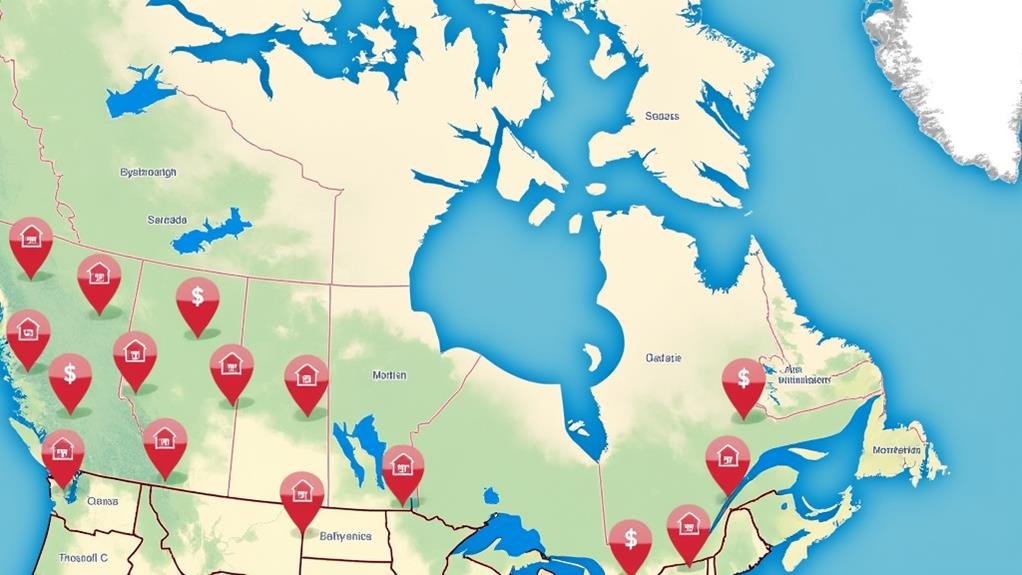
To qualify for a mortgage in Canada, you need to meet specific financial requirements, which vary greatly based on the property’s price and location. As of March 2024, the average income required to purchase a home is approximately $152,000, but this number can fluctuate considerably depending on where you’re buying.
Lenders assess affordability using two key ratios: the Gross Debt Service (GDS) ratio, which should be less than 39%, and the Total Debt Service (TDS) ratio, which shouldn’t exceed 44% of your gross income.
For instance, if you’re aiming for a $600,000 mortgage, you’d need an annual income of around $140,813 to meet these debt service ratios and qualify for the mortgage.
It’s also important to note that the minimum down payment for homes priced under $500,000 is 5%, while properties over $1 million require a 20% down payment.
Furthermore, mortgage stress tests require you to qualify at a higher interest rate, set at the greater of the current mortgage rate plus 2% or a benchmark rate of 5.25%, which can impact your borrowing capacity.
Loan-to-Value Ratios Impact Qualifying Rate
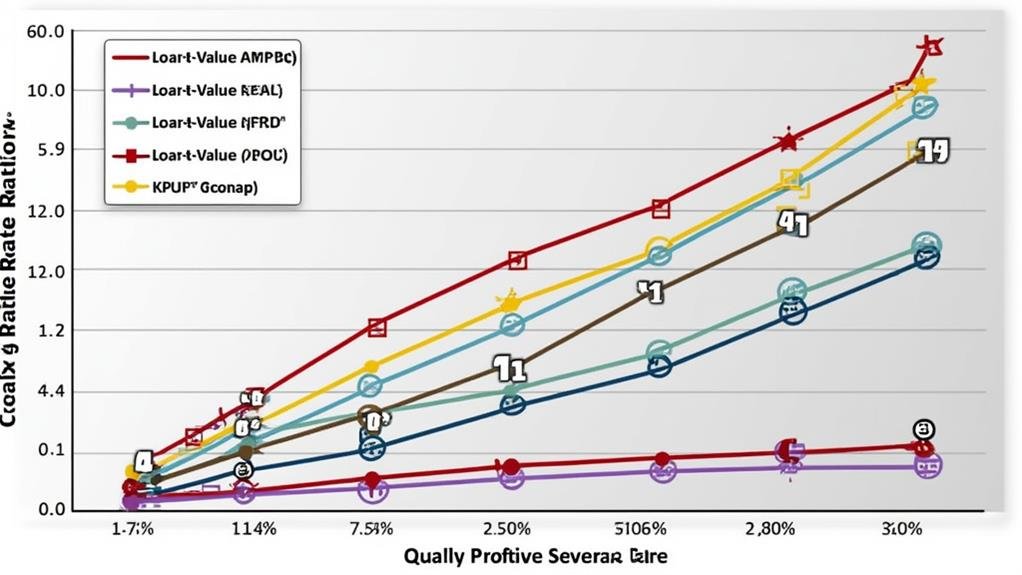
The Loan-to-Value (LTV) ratio plays an essential role in determining the qualifying rate for a mortgage in Canada. This ratio is calculated by dividing the mortgage amount by the appraised value of the property. Lenders use the LTV to assess the risk associated with a mortgage, with lower ratios generally leading to lower interest rates and more favorable terms.
If your LTV is greater than 80%, you’ll need mortgage default insurance, which can increase the overall cost of your loan. However, if your LTV is 80% or less, you can access lower interest rates and avoid this insurance, reducing the income needed to qualify for a mortgage.
The maximum allowable LTV for insured mortgages is typically 95%, meaning you need at least a 5% down payment.
Lenders also consider your income to guarantee that your total monthly housing costs remain within acceptable debt service ratios, such as a maximum Gross Debt Service (GDS) of 39% and Total Debt Service (TDS) of 44%.
Understanding the impact of LTV on your qualifying rate can help you make informed decisions when applying for a mortgage.
Capacity to Service a Mortgage Payment

Your ability to service a mortgage payment is a vital factor lenders evaluate when determining your eligibility for a mortgage in Canada. This assessment is essential because lenders want to guarantee you can handle the financial responsibilities of homeownership.
Two key ratios come into play here: the Gross Debt Service (GDS) ratio and the Total Debt Service (TDS) ratio.
The GDS ratio calculates the percentage of your gross monthly income needed to cover your housing costs, including mortgage payments, property taxes, and heating costs. This figure shouldn’t exceed 39% of your gross monthly income.
For a home priced at $500,000 with a 20% down payment, you’d need an annual income of about $125,535 to keep within these limits, assuming typical property tax rates.
The TDS ratio, on the other hand, includes all your debt payments and must stay below 44% of your gross monthly income. This means your combined debt payments, including car loans, credit cards, and other debts, shouldn’t consume more than 44% of your income.
Understanding these ratios and guaranteeing you stay within them is key to enhancing your chances of mortgage approval.
Debt Service Ratios Impact Mortgage Amount
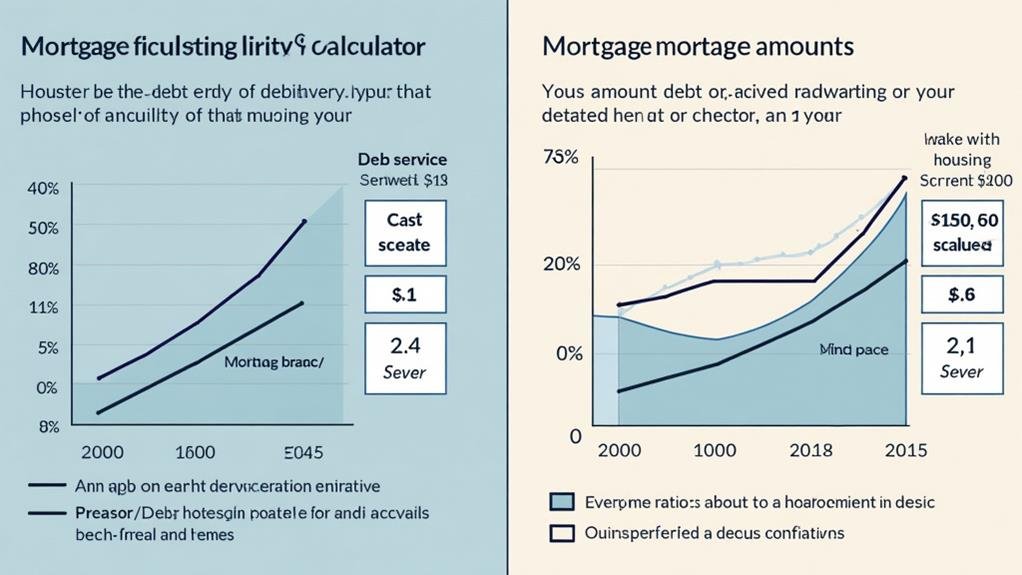
Debt service ratios play a vital role in determining how much mortgage you can qualify for in Canada. Lenders use two key ratios: Gross Debt Service (GDS) and Total Debt Service (TDS), to assess your ability to handle mortgage payments.
The GDS ratio measures the proportion of your gross income that goes towards housing costs, such as mortgage payments, property taxes, and heating. The TDS ratio, on the other hand, encompasses all your debt obligations, including housing and other debts like car loans and credit cards.
For CMHC-insured mortgages, the maximum allowable GDS ratio is typically 39%, and the TDS ratio is 44%. To give you a better idea, if your household has a gross monthly income of $6,000, your maximum housing costs shouldn’t exceed $2,340, or 39% of your income, to meet the GDS requirements.
Keeping these ratios in mind is essential because lenders prefer borrowers who demonstrate manageable debt levels relative to their income.
Maintaining lower debt service ratios greatly enhances your chances of mortgage approval. For example, if you’re planning to buy a home with a monthly housing cost of $2,500, you’ll need to verify your income is high enough to keep your GDS ratio below 39% to qualify for the mortgage.
Mortgage Default Insurance Requirements

Mortgage default insurance becomes mandatory in Canada when home buyers put down less than 20% of the purchase price. This insurance protects lenders against borrower default, and its premiums are calculated based on the size of the down payment.
The premiums range from 2.8% to 4% of the mortgage amount, which you pay in your monthly mortgage payments, adding to your overall housing costs.
For example, if you put down 5% on a $400,000 home, your mortgage amount would be $380,000. At a premium rate of 4%, you’d pay $15,200 in insurance premiums. This cost is typically added to your mortgage, so you don’t pay it upfront. However, you’ll pay interest on it over the life of your mortgage.
Government backing for mortgage default insurance allows high-risk borrowers to access better mortgage rates and terms, despite making smaller down payments. This can help you buy a home sooner, but remember, it doesn’t protect you if you default on your mortgage payments.
You’re still responsible for any shortfall after the sale of the property.
Mortgage Affordability Across Provinces
The cost of homeownership in Canada varies considerably by province and city, with the income required to qualify for a mortgage differing substantially across different regions.
Take St. John’s, for instance, where you’d need an income of $76,720 to buy an average-priced home of $349,700. Now, compare that to Vancouver, where the average home price is a whopping $1,197,700, requiring an income of approximately $260,232. That’s a huge difference.
In Ontario, specifically in Toronto, the average home price is $1,097,300, and you’d need a qualifying income of around $152,000. Recent mortgage rate declines have even decreased the required income by $5,410.
On the other hand, cities like Regina and Fredericton have seen their home prices rise, despite lower mortgage rates, necessitating higher incomes.
Alberta’s Calgary offers a different picture, with income requirements fluctuating based on local market conditions, generally lower than those in British Columbia’s larger cities.
The Prairie provinces, such as Saskatoon and Winnipeg, present lower income thresholds for average homes, making them more accessible for potential buyers.
Income Needed for Average Home Prices
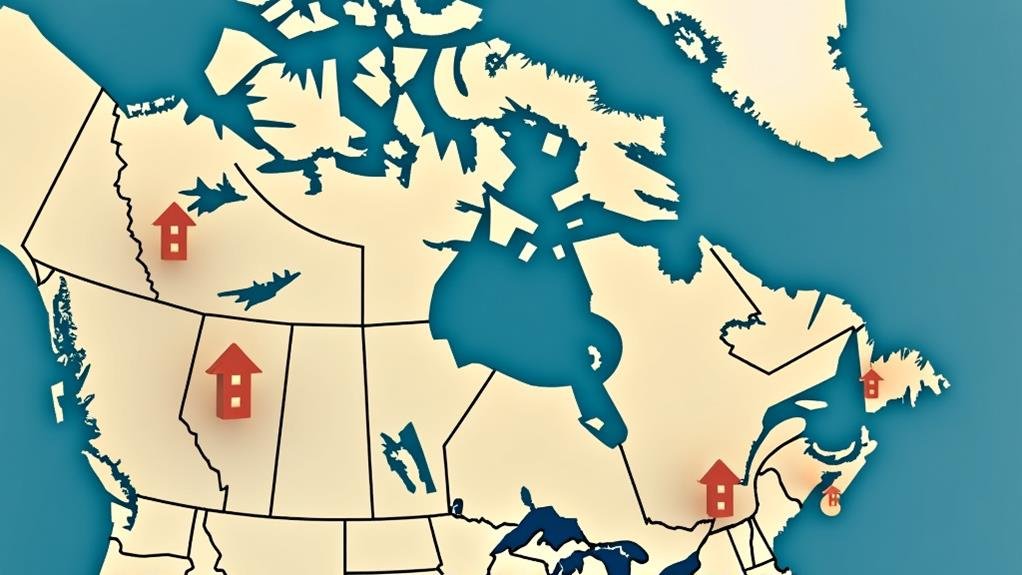
Qualifying for a mortgage in Canada requires a significant income, which varies greatly depending on the province and city. Let’s explore the specifics to give you a clearer picture.
To qualify for a mortgage on the average home in Canada, which costs approximately $738,000, you’d need an annual income of about $152,000 as of March 2024. This is a substantial amount, but it’s important to recognize that prices and required incomes can fluctuate based on recent rate cuts and market conditions.
In cities like St. John’s, where the average home price is $349,700, the required income is more manageable at around $76,720.
Toronto and Vancouver, with their higher average home prices of $1,097,300 and $1,197,700, respectively, also saw slight decreases in required incomes due to recent rate decreases.
For instance, in Toronto, the required income dropped by approximately $5,410, and in Vancouver, it decreased by about $5,020.
Hamilton, with an average home price of $843,500, saw a decrease of roughly $3,510 in the required income for mortgage qualification.
Understanding these numbers can help you plan your home-buying journey more effectively.
In Closing
To qualify for a mortgage in Canada, you need to contemplate several factors, including your income, debt-to-income ratio, and mortgage default insurance requirements. The income needed varies greatly across provinces, ranging from $63,000 in Newfoundland and Labrador to $203,000 in British Columbia. Generally, you’ll need an income at least three to three and a half times the mortgage amount, depending on the down payment and interest rates.